How to Manage Drafty Window Frames: A Definitive Building Science Reference
How to manage drafty window frames the presence of a draft within a residential structure is frequently misinterpreted as a minor inconvenience or a localized aesthetic failure. In reality, a draft is a symptom of a systemic breakdown in the building’s thermal envelope, specifically at the interface between the fenestration unit and the wall assembly. When air moves unhindered through a window frame, it signifies a failure of pressure equalization and a compromise of the structure’s hygrothermal integrity. Managing these air leaks is not merely about comfort; it is a critical intervention in the lifecycle of the building materials, as air often carries the moisture that facilitates interstitial rot and mold.
Modern building science emphasizes that a window is a moving machine. It must expand and contract with diurnal temperature swings, resist wind-load pressures, and operate smoothly for decades. When a frame becomes drafty, it is often because the tolerances of this machine have been exceeded. Whether the cause is the degradation of the “sacrificial” sealants or the physical warping of the sash, the management of the breach requires a diagnostic approach. This article serves as an authoritative exploration into the physics of air leakage and the strategic protocols required to restore the thermal and structural equilibrium of the home.
Understanding “how to manage drafty window frames”
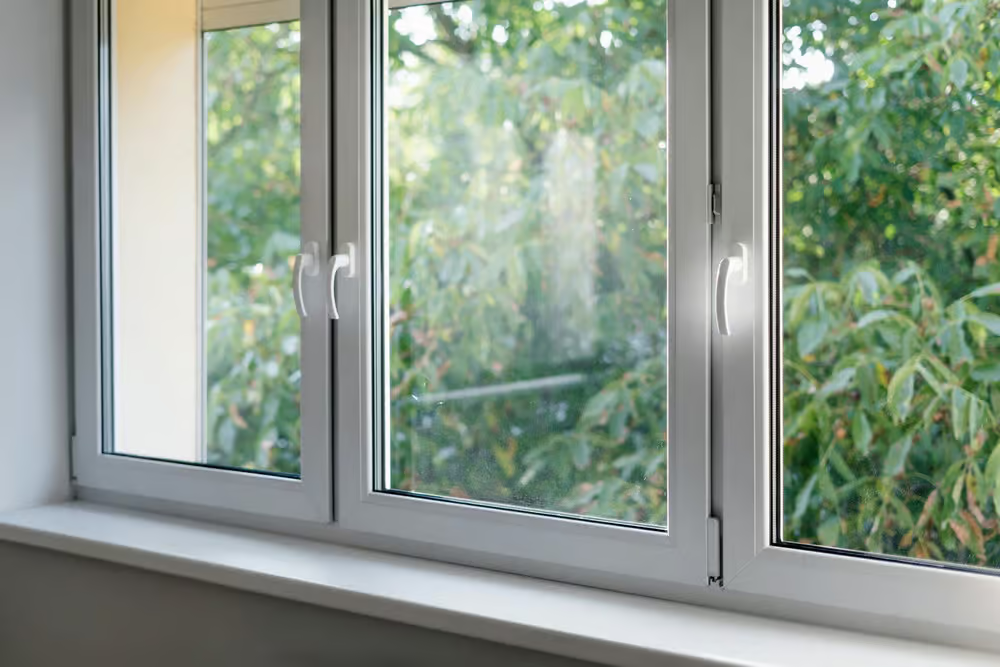
To effectively address how to manage drafty window frames, one must first dismantle the oversimplification that air leakage is always caused by the glass. In professional architectural circles, the “draft” is often localized to the “rough opening”—the space between the window unit and the structural studs—or at the meeting rail where two sashes overlap. A common misunderstanding in the consumer market is that a drafty window must be replaced. In many cases, the unit itself is structurally sound, but the “perimeter seal” or the “weather-stripping” has reached the end of its functional life.
The risk of oversimplification often centers on the DIY application of caulk. While caulking is a fundamental tool, applying it to the wrong part of a window frame can be disastrous. For example, sealing the “weep holes” on the exterior of a sliding or vinyl window will stop a draft, but it will also trap water inside the frame, leading to structural rot and eventual window failure. A sophisticated management plan recognizes that windows are designed to be “leaky” in specific, controlled ways to facilitate drainage, while remaining airtight in others to prevent convective heat loss.
Another perspective involves the “Mechanical Alignment” of the sashes. A draft is often a symptom of a sash that is no longer “square” within its frame. If a house has settled, even by a fraction of an inch, the locking mechanism may not pull the sash tightly enough against the weather-stripping to create a compression seal. Therefore, the management process must begin with a structural audit: is the window plumb, level, and square? If the mechanical foundation is flawed, no amount of sealant or weather-stripping will provide a permanent solution.
Deep Contextual Background: The Evolution of Airtightness
How to manage drafty window frames the history of the American window is a progression from “loose” assemblies to “hermetic” systems. In the 18th and 19th centuries, windows were expected to leak. Wood sashes were built with significant tolerances to allow for the natural swelling of the timber in humid months. To mitigate drafts, homeowners used “heavy-hang” curtains and sandbags—rudimentary solutions for a time when energy was cheap and manual labor for hauling wood or coal was the norm.
The mid-20th century introduced the “storm window” as the primary defense against drafts. By adding a second layer of glass and frame on the exterior, homeowners created a “dead air” space that acted as a buffer. However, the modern era of airtightness began in earnest after the 1970s energy crisis. This period saw the rise of the “fusion-welded” vinyl frame and the sophisticated “multi-point” locking system. These innovations were designed to turn the window into a hatch that compresses a rubber or foam gasket when closed.
Today, we are in the era of “High-Performance Retrofitting.” We have moved away from the binary choice of “caulk it or replace it.” With the advent of specialized “Low-E” storm inserts and high-density “closed-cell” spray foams, we can now achieve Passive House levels of airtightness in older structures. The evolution of “how to manage drafty window frames” has moved from a cosmetic repair to a high-precision application of building physics.
Conceptual Frameworks and Mental Models How To Manage Drafty Window Frames
To analyze air leakage with professional rigor, the following mental models should be applied:
1. The “Pressure Differential” Framework
This model views the window as a barrier between two different pressure zones. Air does not move through a frame simply because a gap exists; it moves because there is a pressure difference. The mental model dictates that if you want to stop a draft, you must address the “driving force,” which often involves managing the overall building pressure through balanced ventilation.
2. The “Drainage Plane” Logic
This framework posits that every window assembly must have a path for water to exit. When managing a draft, the mental model prioritizes the “weep path.” Any repair that interferes with the window’s ability to shed water is a failure, regardless of how airtight it makes the room.
3. The “Sacrificial Seal” Strategy
This model recognizes that sealants and weather-stripping are intended to fail. Unlike the glass or the frame, which are “permanent” assets, gaskets are sacrificial. The mental model assumes a 7-to-10-year replacement cycle for all flexible components of the frame.
Technical Categories of Remediation
When addressing air leakage, the interventions are categorized by their “Permanence” and “Structural Depth.”
Decision Logic: The “Smoke Test” Pivot
Before selecting a category, the “Decision Logic” pivots on the Location of the Leak. If a lit incense stick or a smoke pen indicates air moving between the sash and the frame, the solution is mechanical or gasket-based. If the air is moving between the frame and the trim, the solution is structural infill or perimeter re-sealing.
Detailed Real-World Scenarios How To Manage Drafty Window Frames
Scenario A: The Historic “Weight-and-Pulley” Leak
A 1920s Victorian with original double-hung wood windows. Air is “pouring” out of the sides of the frames.
-
The Diagnostic: The “weight pockets”—hollow cavities inside the wall where the sash weights hang—are acting as chimneys for cold air.
-
The Strategy: Carefully remove the interior trim and fill the weight pockets with “Slow-Rise” closed-cell foam. Replace the heavy weights with modern “Spring Balances” to allow for a fully insulated cavity.
-
Failure Mode: Stuffing fiberglass batt into the pocket, which eventually absorbs moisture and rots the studs.
Scenario B: The “Warped” Vinyl Slider
A 10-year-old vinyl sliding window in a high-heat climate. The meeting rail (where the two sashes overlap) has a visible gap.
-
The Diagnostic: “Solar Pumping” or thermal expansion has caused the vinyl to “smile” or bow slightly, pulling it away from the interlock.
-
The Strategy: Install “Interlock Weather-stripping” and adjust the rollers to lift the sash, forcing a tighter connection. In extreme cases, a “Reinforcement Bar” may be added to the sash.
Scenario C: The Modern “Performance” Failure
A new-construction home with high-end casement windows that still feel drafty.
-
The Diagnostic: The builder used standard “Fiberglass” insulation around the rough opening instead of air-sealing foam, and the windows weren’t properly “tensioned” during install.
-
The Strategy: Remove the interior “stop” molding, apply a bead of “Liquid Flashing” or high-performance sealant, and re-tension the multi-point locks.
Planning, Cost, and Resource Dynamics How To Manage Drafty Window Frames
The economics of managing drafts vary based on whether the labor is specialized or general.
Range-Based Resource Allocation
The “Opportunity Cost” of ignoring a drafty frame is the potential for Structural Rot. If air is leaking, water vapor is moving. Over a five-year period, the cost of remediating a rotted “sill plate” or “jack stud” can exceed the cost of replacing the entire window ten times over.
Support Systems: Tools and Strategies
To move from “guessing” to “governing” the thermal envelope, the following diagnostic systems are required:
-
Thermal Imaging (Infrared): The “Gold Standard” for locating drafts. It visualizes the “thermal bloom” of cold air entering the frame.
-
Smoke Pens / Puffers: Essential for identifying low-velocity air movement that is invisible to the eye but felt by the skin.
-
Digital Calipers: Used to measure the “Gap Tolerance” of the sash. If a gap is wider than 1/4 inch, standard weather-stripping will not work; a “Bulb Seal” or mechanical adjustment is required.
-
Low-Expansion “Window & Door” Foam: Specifically formulated not to bow the frame as it cures.
-
Spectrally Selective Films: Useful when the “draft” is actually a “downdraft” caused by radiant cooling off of the glass.
-
Acoustic Sealant: Stays flexible for decades; superior to standard “Painter’s Caulk” for air-sealing.
Risk Landscape and Failure Modes How To Manage Drafty Window Frames
The “Risk Taxonomy” of window repair is defined by the unintended consequences of stopping air flow.
-
The “Moisture Trap” Risk: Sealing the interior so tightly that interior humidity cannot escape, causing condensation to form on the cold glass and rot the wooden sashes.
-
The “Frame Bow” Risk: Using high-expansion “Big Gap” foam in a window frame. The pressure of the foam can bend the frame, making the window impossible to open or close.
-
The “Lead Paint” Risk: In homes built before 1978, disturbing the sash or trim to fix a draft can release lead dust. Management must include “Lead-Safe” work practices.
-
The “Egress” Failure: Applying temporary plastic films or permanent seals to a window that is designated as a fire exit.
Governance, Maintenance, and Long-Term Adaptation
Draft management is a “Review Cycle,” not a singular event.
The Thermal Integrity Review Cycle
-
Pre-Winter (October): “The Candle Test.” Check for air movement at the meeting rails and sills. Lubricate locks to ensure maximum compression.
-
Post-Winter (April): Inspect the exterior caulk for “adhesion failure.” Winter contraction often pulls the caulk away from the siding.
-
5-Year Interval: Full gasket replacement. Rubber and foam gaskets lose their “memory” (resiliency) and no longer expand to fill the gap.
-
Adaptive Triggers: If you notice a “whistle” during a windstorm, the frame has shifted or the weather-stripping has compressed beyond its limit.
Measurement, Tracking, and Evaluation
How do you evaluate if you have successfully managed the draft?
-
Leading Indicator: “Surface Temperature.” Use an IR thermometer on the frame. If the frame temperature is within 5 degrees of the wall temperature, the air-seal is holding.
-
Lagging Indicator: “The Blower Door Test.” A professional energy auditor depressurizes the house and measures the “Air Changes per Hour” (ACH). A significant drop in ACH proves the effectiveness of the frame repairs.
-
Qualitative Signal: “The Noise Floor.” Sound travels on air. If the room feels significantly quieter, you have successfully stopped the air infiltration.
Common Misconceptions and Oversimplifications How To Manage Drafty Window Frames
-
Myth: “A draft means the window is broken.” Reality: It usually means the sealant or adjustment is broken.
-
Myth: “New windows pay for themselves in 5 years.” Reality: The ROI for new windows is often 20+ years. High-quality repair of existing frames often has a 2-to-3-year ROI.
-
Myth: “Caulk is the only solution.” Reality: Caulk is for static gaps; weather-stripping is for moving gaps. Using caulk on a moving sash will break the first time you open it.
-
Myth: “Thick curtains stop drafts.” Reality: Curtains hide the feeling of a draft but do not stop the energy loss or the moisture movement into the wall.
-
Myth: “Double-pane glass never leaks air.” Reality: The glass is airtight, but the spacer and the frame are not. Most drafts come from the frame, not the glass itself.
Ethical and Practical Considerations
In the context of the “Climate Crisis,” managing drafty windows is an act of “Energy Ethics.” Buildings account for nearly 40% of global carbon emissions, and a significant portion of that is wasted through leaky envelopes. Practically, we must also consider “Historical Stewardship.” In many American cities, original wood windows are part of the local heritage. Finding ways to how to manage drafty window frames through non-destructive retrofitting—rather than replacement—is a way of preserving the architectural soul of a neighborhood while meeting modern efficiency standards.
Conclusion: The Resilience of the Envelope
The management of a drafty window frame is an ongoing negotiation with the forces of physics and the aging of materials. It is a process that requires both the analytical mind of a building scientist and the patience of a craftsman. By prioritizing diagnostic accuracy over quick-fix retail products, the property owner ensures the longevity of the structure and the health of its occupants. A draft is not an inevitability of an old home; it is a signal that the building is asking for maintenance. When addressed with rigors and intelligence, the “breach” becomes a site of structural renewal and thermal resilience.